

By Rolla Hassan, Ph.D
FWA stands for Fixed Wireless Access. It is a broadband internet connection technology that uses wireless communication to deliver high-speed internet access to fixed locations, such as homes, businesses, and other premises.
FWA utilizes wireless signals, typically transmitted over radio frequencies, to establish a connection between the service provider’s network and the customer’s premises. Unlike traditional wired connections, FWA does not require physical cables to be laid to the premises and can be deployed faster.
It can provide high-speed internet access in urban and rural areas, bridging the digital divide and reaching underserved or remote locations. FWA can be used for various applications, including residential internet access, business connectivity, and even as a backup or temporary solution in areas affected by natural disasters or network outages. It is a flexible and scalable technology that can adapt to different user demands and network requirements. FWA can be delivered using various wireless technologies, such as cellular networks (4G and 5G).
How can service providers address the needs of different household segments?
Service providers can address the needs of different household segments by adopting a localized and segmented approach. Here are some strategies they can consider:
1- Value-based offerings: For households driven by price, service providers can offer value-based packages that cater to price-sensitive customers. This can include affordable FWA plans or bundled offers that provide cost-effective connectivity solutions.
2- Performance-based offerings: To meet the needs of households seeking enhanced performance, service providers can focus on providing performance-based offerings. This can involve offering high-speed FWA plans, ensuring reliable connectivity, and addressing the need for increased capacity and coverage.
3- Performance-based offerings: To meet the needs of households seeking enhanced performance, service providers can focus on providing performance-based offerings. This can involve offering high-speed FWA plans, ensuring reliable connectivity, and addressing the need for increased capacity and coverage.
4- Bundling opportunities: Many households are attracted to bundled offers that combine services. Service providers can explore bundling options, including FWA connectivity and other services such as mobile connections, entertainment packages, or home security solutions. This can appeal to households seeking convenience and a comprehensive solution.
Global 5G FWA adoption
The proportion of 5G fixed wireless access (FWA) connections is expected to increase from 6% in 2020 to 84% by 2029. 5G FWA will surpass 4G FWA by 2025.

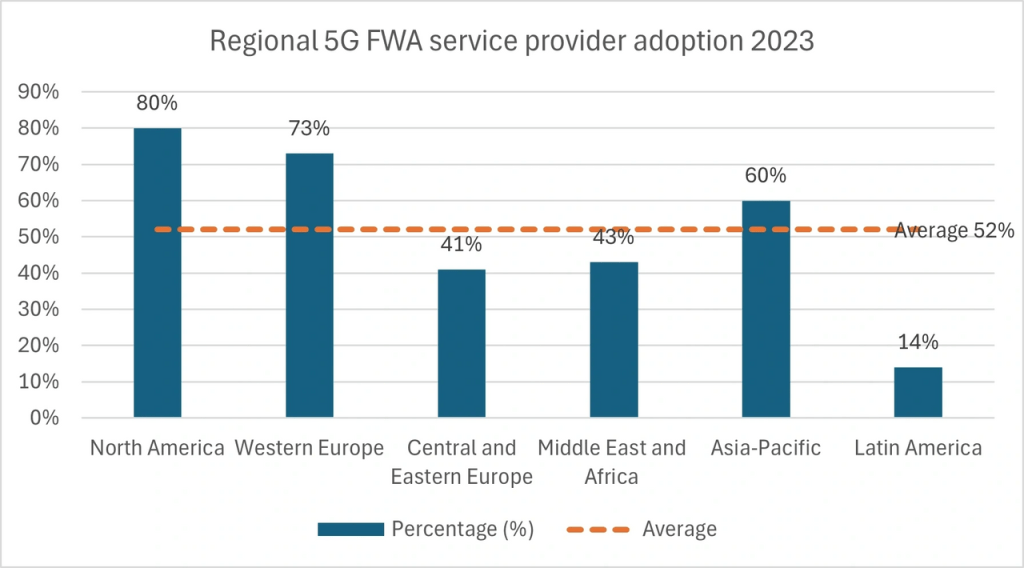
Over 80 percent of mobile service providers offer FWA in the regions of North America, Western Europe, Central and Eastern Europe, the Middle East, and Africa.
Availability of speed-based plans
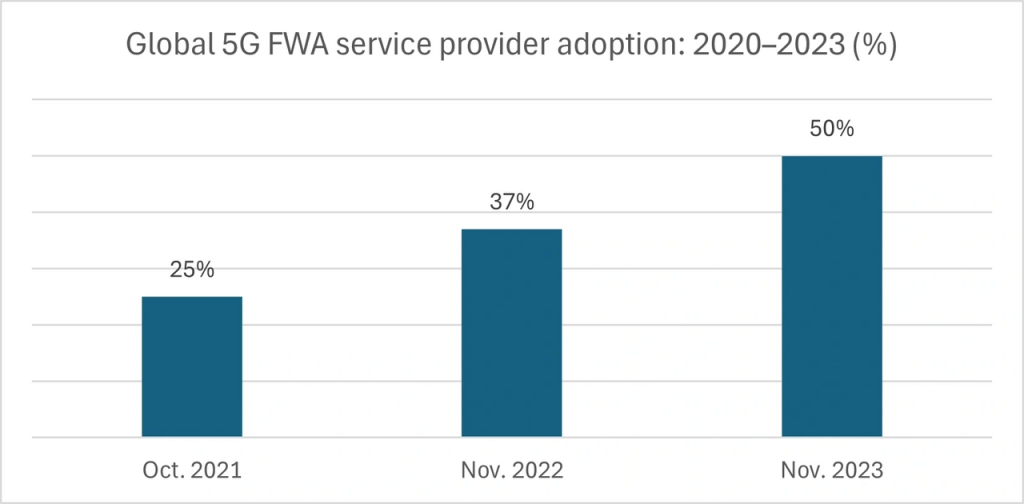
FWA service providers now offer speed-based tariff plans to 37% of customers, up from 25% last year.
How does the installation of outdoor CPE improve signal quality in FWA?
Installing outdoor Customer Premises Equipment (CPE) in Fixed Wireless Access (FWA) improves signal quality in several ways. It provides better line-of-sight conditions, allowing for a clear signal path without obstacles. Outdoor CPEs often have advanced antenna arrangements, such as directional or multiple antennas, improving signal reception and transmission. By being positioned outside, outdoor CPEs minimize interference from indoor obstacles, resulting in a cleaner signal. They can also be strategically placed to optimize signal propagation, leading to better coverage and reach. Overall, installing outdoor CPEs in FWA maximizes line-of-sight, utilizes advanced antenna technology, minimizes interference, and optimizes signal propagation, resulting in a stronger and more reliable connection for FWA users.
What is the capacity difference between mid-band-only and mmWave deployment?
Ericsson’s study shows that adding mmWave in a combined mid-band and mmWave deployment can result in a threefold increase in capacity compared to a mid-band-only deployment.
In the study, the mid-band-only deployment with 100 MHz of mid-band spectrum achieved a capacity of 1,200 Mbps per site. However, when 400 MHz of mmWave spectrum was added to the deployment, the capacity increased to 3,600 Mbps per site. This increase in capacity is attributed to mmWave’s ability to serve many users in close proximity to the base station, allowing for offloading of lower bands and enabling higher data rates.
It is important to note that the capacity difference between mid-band-only and mmWave deployment may vary depending on factors such as the amount of spectrum available, the specific deployment scenario, and the network configuration. The study conducted by Ericsson provides a specific example, and actual capacity differences may vary in different deployments.
How does mmWave FWA improve connectivity in rural areas?
mmWave FWA improves connectivity in rural areas by offering high capacity, line-of-sight, and non-line-of-sight coverage, rapid deployment, flexibility, and scalability, and bridging the digital divide. It extends range, provides high capacity, offloads lower bands, offers wireless fiber services, and enables higher data rates. This allows for the delivery of high-speed broadband services to rural areas, bridging the digital divide and providing reliable connectivity for residents, businesses, and institutions.
Which regions/countries have reported strong 5G FWA uptake?
Several regions have reported strong 5G Fixed Wireless Access (FWA) uptake. These include:
- North America: Verizon and T-Mobile have reported strong 5G FWA uptake in North America, leading to accelerated connection growth.
- Europe: Market uptake of 5G FWA has been concentrated in certain regions, such as the Nordics, Italy, and the UK. Telenor Norway, for example, has used 5G FWA to decommission their copper networks.
- Middle East: The Middle East has shown strong 5G FWA momentum, particularly in countries like Oman, Saudi Arabia, and the UAE. Service providers in these markets actively market home internet solutions based on fiber or 5G FWA, and they are also migrating 4G FWA connections to 5G FWA.
- Japan: Japan has seen strong 5G FWA connection growth since launching services in late 2021. DoCoMo, one of the major service providers in Japan, has reported this growth.
- Australia: All major service providers in Australia, including Telstra, Optus, NBN, and TPG, have reported strong 5G FWA growth. TPG, for instance, surpassed 200 thousand connections during 2023.
- Emerging Markets: There have been several 5G FWA launches in emerging markets across Latin America, the Middle East and Africa, and Asia-Pacific. These markets have many unconnected and underserved homes that could benefit from fast and reliable FWA-delivered broadband. India’s Reliance Jio, for example, has committed to connecting 100 million homes and SMEs with 5G FWA.
It’s important to note that these regions have reported strong 5G FWA uptake, but the level of adoption may vary within each region.
Data sources:
Ericsson Fixed Wireless Access handbook Insights 2024
https://www.ericsson.com/en/fixed-wireless-access
Ericsson Capturing the 5G FWA opportunity: A household view 2024
Ericsson Realizing the 5G FWA growth opportunity February 2023


 Telecom Analysis
Leave a comment