

By Rolla Hassan, Ph.D
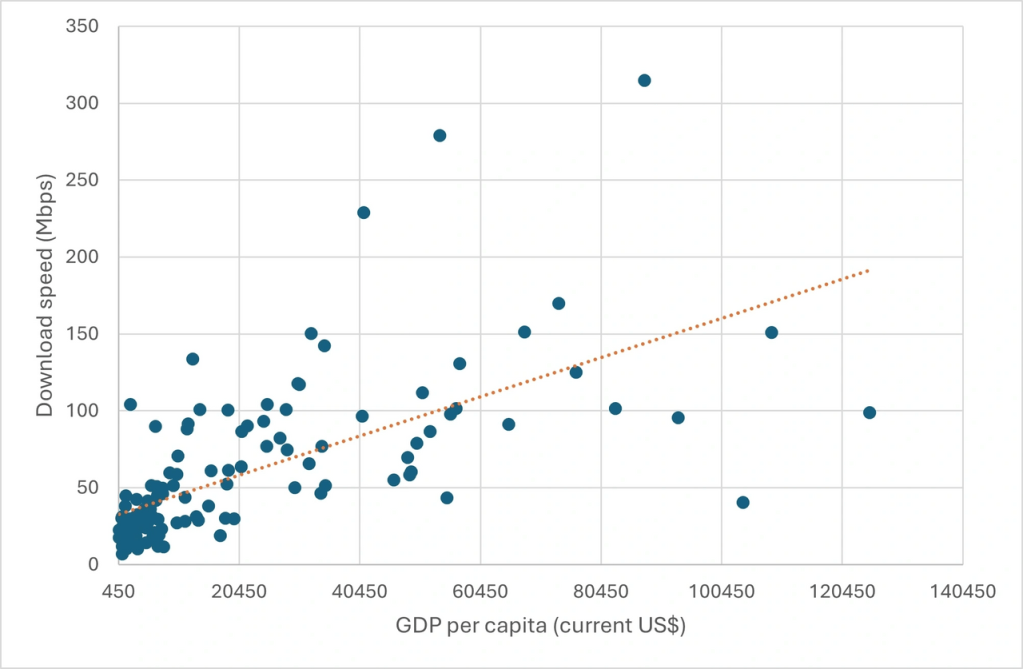
In an increasingly digital world, the speed at which we can access information and communicate online has become critical for economic growth. Mobile download speeds are a crucial indicator of a country’s technological infrastructure and connectivity. However, is there a connection between mobile download speed and GDP per capita? Evidence suggests that there is indeed a positive correlation between these two variables, with faster download speeds often accompanying higher levels of economic prosperity.
The Role of Mobile Connectivity in Economic Development
Mobile internet access has revolutionized how businesses operate, governments function, and individuals communicate. Fast and reliable mobile networks are essential for:
- Business Efficiency: High-speed mobile internet allows businesses to operate more efficiently, with quick access to cloud services, data analytics, and communication tools. This boosts productivity and innovation, leading to economic growth.
- E-Commerce and Digital Services: Faster download speeds enable the growth of e-commerce and digital services. Consumers are more likely to engage in online shopping, banking, and other digital transactions when they can do so seamlessly.
- Education and Skills Development: Access to high-speed internet facilitates online education and skills training, which are crucial for a modern workforce. This, in turn, can enhance a country’s human capital, driving economic development.
- Government Services and Efficiency: E-government services rely on robust digital infrastructure. Fast mobile internet speeds improve the delivery of public services and make governments more responsive and efficient.
Challenges and the Way Forward
While the correlation between mobile download speed and GDP per capita is evident, achieving and maintaining high-speed mobile internet is challenging. Issues such as regulatory hurdles, high infrastructure costs, and the need for continuous technological upgrades must be addressed.
Governments and private sectors must collaborate to prioritize investments in digital infrastructure. Policies encouraging competition among telecom providers streamline regulatory processes and support technological innovation, which are crucial for sustained economic growth.
Conclusion
The positive correlation between mobile download speed and GDP per capita highlights the importance of digital infrastructure in modern economies. As countries continue to invest in and improve their mobile internet capabilities, they can expect corresponding economic prosperity increases. Fast and reliable mobile networks are a convenience and a vital component of economic development in the digital age.
Data source: Ookla download speed, World Band


 Telecom Analysis
Leave a comment