

By Rolla Hassan, Ph.D
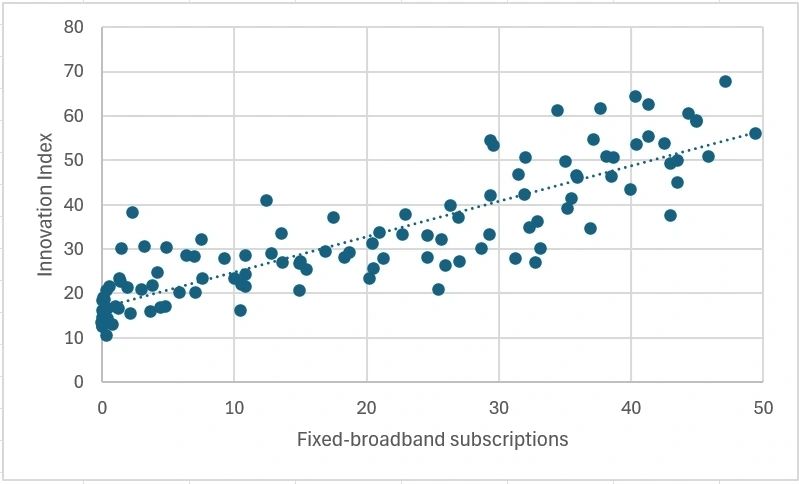
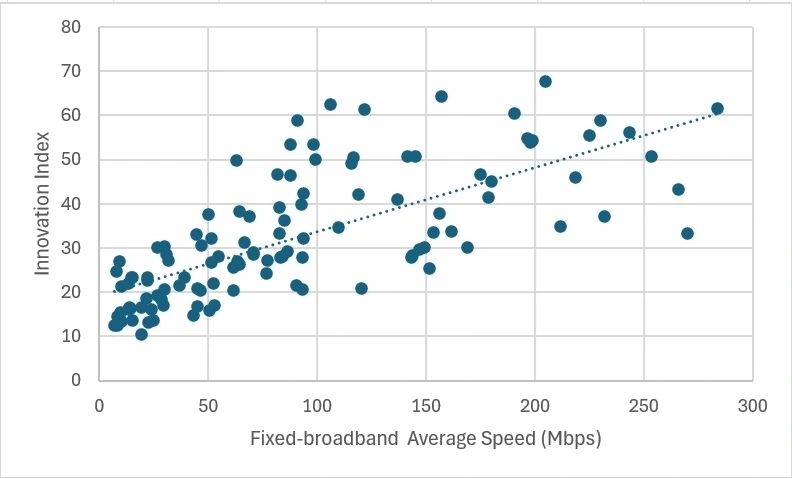
In the digital age, internet connectivity is the backbone of economic growth and innovation. Recent analyses by Telecom Analysis have revealed strong correlations between fixed-broadband subscriptions and fixed-broadband average speed with the Innovation Index, with correlation coefficients of 0.86 and 0.71, respectively. These findings highlight the importance of broadband access and quality in fostering a conducive environment for innovation.
Understanding the Correlations
The correlation coefficients indicate a positive relationship between broadband metrics and the Innovation Index. A coefficient of 0.86 for broadband subscriptions suggests that countries with higher broadband penetration are more likely to exhibit higher levels of innovation. Similarly, a coefficient of 0.71 for broadband speed underscores the importance of fast internet connections in driving innovative capacities.
Why Fixed-Broadband Matters
- Access to Information: High-speed and widespread internet access provides unprecedented access to information, research, and educational resources. This enables continuous learning and the rapid dissemination of innovative ideas.
- Collaboration and Communication: Broadband connectivity facilitates global collaboration among researchers, developers, and businesses. Tools like video conferencing, cloud computing, and collaborative software allow real-time exchange of ideas, accelerating innovation.
- Economic Opportunities: A robust broadband infrastructure opens new economic opportunities, enabling e-commerce, digital marketing, and online services to thrive. This leads to the creation of innovative business models and market expansion.
- Government and Policy Support: Countries with high broadband penetration often have supportive policies and investments in digital infrastructure. This encourages innovation through grants, subsidies, and favorable regulations.
Impact of Broadband Speed
- Enhanced Productivity: High-speed internet enables faster data transfer, reducing latency and improving the efficiency of digital activities, which is crucial for research, development, and innovation.
- Support for Advanced Technologies: Many cutting-edge technologies, such as AI, big data analytics, and cloud computing, require high-speed internet. Faster broadband speeds ensure these technologies function effectively.
- Improved User Experience: Faster internet speeds improve user experiences, making digital tools and resources more accessible and efficient and driving higher engagement in innovative activities.
- Facilitation of Complex Projects: High-speed broadband supports complex, data-intensive projects, such as genome sequencing in healthcare, real-time simulations in engineering, and large-scale collaborative research.
Sectoral Impacts
- Healthcare: High-speed internet supports telemedicine, electronic health records, and health monitoring apps, improving healthcare delivery and innovation.
- Education: E-learning platforms, digital classrooms, and online courses rely on fast broadband for interactive and personalized learning experiences.
- Business and Industry: Broadband connectivity drives industrial innovation through smart manufacturing, automation, and IoT technologies, optimizing operations and enhancing productivity.
- Agriculture: Precision farming, drone technology, and IoT applications in agriculture rely on broadband to improve crop yields and manage resources efficiently.
Global Trends and Insights
Countries leading in broadband subscriptions and speeds, such as South Korea, Sweden, Singapore, and Japan, provide valuable insights. These nations have invested heavily in digital infrastructure, education, and research and development (R&D), creating environments where innovation can thrive.
Challenges and the Way Forward
Despite strong correlations, challenges remain. Digital divides persist, particularly in developing regions where broadband access is limited. Bridging this gap requires substantial investment, international cooperation, and innovative solutions to make broadband affordable and accessible.
To leverage the relationship between broadband and innovation, policymakers should focus on:
- Expanding Infrastructure: Ensuring widespread availability of high-speed internet, especially in rural and underserved areas.
- Promoting Digital Literacy: Educating the population on using digital tools and resources effectively.
- Supporting R&D: Investing in research and development to drive technological advancements and innovative solutions.
- Encouraging Public-Private Partnerships: Collaborating with private companies to develop and implement broadband infrastructure and services.
Conclusion
The correlations between fixed-broadband subscriptions, broadband speed, and the Innovation Index, as identified by [Your Name], highlight the critical role of digital infrastructure in driving innovation. As nations strive to enhance their innovation capabilities, investing in robust, high-speed broadband networks will be essential. By bridging the digital divide and fostering a conducive environment for innovation, countries can ensure sustainable economic growth and competitiveness in the global arena.


 Telecom Analysis
Leave a comment