

By Rolla Hassan, Ph.D
Introduction
The AI Preparedness Index (AIPI) assesses the level of AI preparedness across 174 countries based on a rich set of macro-structural indicators covering the countries’ digital infrastructure, human capital and labor market policies, innovation and economic integration, and regulation and ethics.
Source data include official data, surveys of hard data, and surveys of perceptions compiled by eight institutions: Fraser Institute, International Labor Organization, International Telecommunication Union, United Nations, United Nations Conference on Trade and Development, Universal Postal Union, World Bank, and World Economic Forum.
The AIPI comprises four key dimensions: digital infrastructure, human capital, technological innovation, and legal frameworks. These four dimensions are likely relevant for smooth AI adoption.

Correlation Analysis

There appears to be a strong positive correlation between most dimensions, mainly:
o Digital Infrastructure and Innovation and Economic Integration (0.707)
o Digital Infrastructure and Regulation and Ethics (0.884)
o Digital Infrastructure and Human Capital and Labor Market Policies (0.865)
Dimension Strengths
· Digital Infrastructure has the highest score (0.957), suggesting it’s the strongest dimension.
· Innovation and Economic Integration has the lowest score (0.823), indicating potential room for improvement.
Balanced Performance:
· The scores across dimensions are relatively close (ranging from 0.823 to 0.957), indicating a fairly balanced preparedness across different aspects of AI readiness.
Potential Focus Areas:
Given its lower score, innovation and economic integration might be areas to prioritize for improvement.
The strong correlation between Digital Infrastructure and other dimensions suggests that improvements in this area could positively impact the board.
Region’s Performance
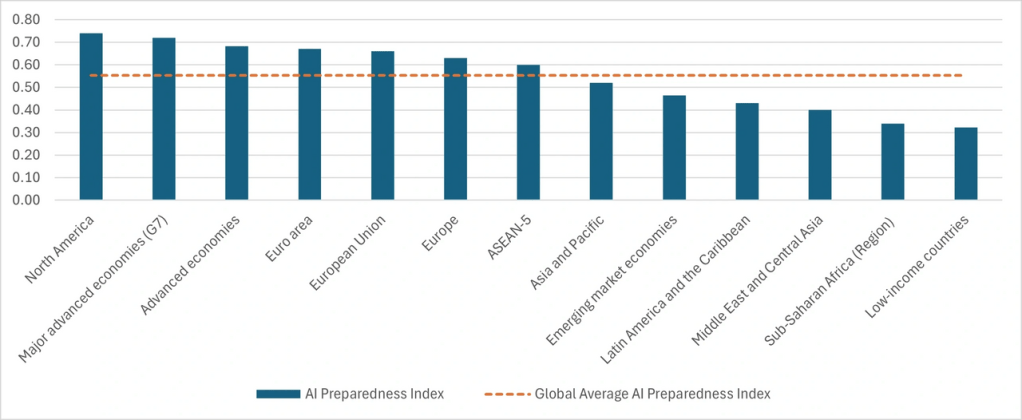
There’s a wide range in AI preparedness across different regions and economic groups, from about 0.32 for low-income countries to 0.73 for North America.
1- Leaders
· North America leads with the highest AIPI score (approximately 0.73).
· Major advanced economies (G7) and advanced economies follow closely behind.
2- Global Average:
- The global average AIPI (the dotted orange line) is around 0.55.
- 7 out of the 14 listed regions/groups are above this average.
3- Economic Development Correlation:
- There’s a clear correlation between economic development and AI preparedness.
- Advanced economies and regions (North America, G7, Euro area, EU) score significantly higher than emerging markets and developing regions.
4- Regional Disparities:
- Significant gaps exist between regions, with Sub-Saharan Africa and low-income countries scoring less than half of North America’s score.
5- Emerging Economies:
- ASEAN-5 and emerging market economies show moderate preparedness, scoring above the global average but below advanced economies.
6- Potential Digital Divide:
- The chart suggests a potential AI-driven digital divide, with low-income countries and regions like Sub-Saharan Africa lagging significantly.
7- Continental Variations:
- Within continents, there are notable differences (e.g., North America vs. Latin America and the Caribbean).
8- EU and Euro Area:
- The European Union and Euro area have strong preparedness but are slightly below the G7 average.
9- Asia’s Position:
- Asia shows varied preparedness levels, with Asia and Pacific scoring moderately, while ASEAN-5 performs better.
10- Middle East and Central Asia:
- This region falls below the global average, indicating room for improvement in AI readiness.
- There’s a clear disparity in AI preparedness across different world regions.
- The index ranges from 0 to 0.800566718, indicating a wide spread of preparedness levels.

Leading Regions
- North America, Western Europe, and Australia appear to have the highest AI preparedness scores, shown in the darkest shade of blue.
- These regions likely have more advanced digital infrastructure, research capabilities, and AI-related policies.
Developing Regions
- Many parts of Africa, South America, and Central Asia show lighter shades of blue, suggesting lower AI preparedness scores.
- This could indicate challenges in digital infrastructure, AI education, or regulatory frameworks.
Notable Outliers
- Some countries in typically developing regions (e.g., parts of the Middle East and South Africa) show higher preparedness levels than their neighbors.
Recommendations
· Global Collaboration: Establish international partnerships and knowledge-sharing programs to help less prepared countries improve their AI readiness. This could involve technology transfers, educational exchanges, and policy guidance.
· Targeted Investment: Developed nations and international organizations should focus investments on regions with lower AI preparedness scores, particularly in Africa, parts of Asia, and South America. This could include funding for digital infrastructure, AI research centers, and education programs.
· Policy Development: Countries with lower scores should prioritize developing comprehensive AI strategies and regulatory frameworks, learning from more prepared nations while adapting policies to their specific contexts.
· Education and Skill Development: Implement widespread AI and digital literacy programs, focusing on countries with lower preparedness scores to build human capital for the AI era.
· Bridging Data Gaps: Encourage participation in AI readiness assessments for countries lacking data to get a more complete global picture and enable targeted interventions.
Conclusion
The AI Preparedness Index map reveals a significant global divide in AI readiness, largely aligning with existing economic and technological disparities. While developed regions in North America, Western Europe, and parts of Asia and Oceania demonstrate high levels of AI preparedness, many developing regions lag behind.
This disparity poses both challenges and opportunities. On one hand, it risks exacerbating global inequalities as AI technologies become increasingly central to economic growth and societal advancement. On the other hand, it presents a clear roadmap for targeted interventions and international cooperation to bridge the AI readiness gap.
The varying levels of preparedness underscore the need for a coordinated global approach to AI development and deployment. By fostering collaboration, sharing knowledge, and providing support to less prepared regions, the international community can work towards a more equitable distribution of AI capabilities and benefits.
Ultimately, improving global AI preparedness is not just a matter of technological advancement, but a crucial step towards ensuring that the benefits of AI are accessible to all, promoting inclusive growth and addressing global challenges collectively.
Source: https://www.imf.org/en/Topics/Artificial-Intelligence


 Telecom Analysis
Leave a comment