

By Rolla Hassan, Ph.D
Introduction
eSIM, or embedded SIM, is a digital version of the traditional physical SIM card used in mobile devices.
Digital format: It’s a small chip built into the device, eliminating needing a physical, removable SIM card. eSIM features are described below:
· Programmable: eSIMs can be programmed remotely with carrier information, allowing users to switch carriers or plans without changing physical SIM cards.
· Multiple profiles: A single eSIM can store multiple carrier profiles, making switching between networks or using different numbers on one device easier.
· Space-saving: By eliminating the need for a physical SIM slot, manufacturers can make devices smaller or use the space for other components.
· Convenience: Users can activate new plans or switch carriers without visiting a store or waiting for a physical SIM to arrive.
· Global travel: eSIMs make it easier to use local carriers when traveling internationally without needing to swap physical SIM cards.
· IoT applications: eSIMs are particularly useful for Internet of Things (IoT) devices, allowing for easier management of many connected devices.
· Adoption: While not universal, eSIM technology is becoming increasingly common in smartphones, tablets, smartwatches, and other connected devices.
eSIM technology offers greater flexibility and convenience for users, though it’s worth noting that not all carriers or devices support eSIM functionality yet. The technology continues to evolve and become more widely adopted.
How eSIM work?
1- Activation and Provisioning:
When a user purchases a device with eSIM support (such as a smartphone, smartwatch, or tablet), the eSIM is pre-installed.
To activate the eSIM, the user needs to contact his mobile carrier or service provider. They’ll provide him with a QR code or activation details.
Scan the QR code or enter the details manually in his device settings to associate his eSIM with your mobile plan.
2- Profile Management:
The eSIM can store multiple profiles (e.g., different mobile carriers or data plans).
The user can switch between profiles without physically changing SIM cards.
3- Remote Provisioning:
Unlike physical SIM cards, eSIMs allow remote provisioning.
If the user wants to switch carriers or plans, his provider can update his eSIM over the air (OTA) without needing a new physical card.
4- Security and Encryption:
eSIMs use encryption to protect your data during activation and communication with the carrier.
They’re tamper-resistant and more secure than traditional SIM cards.
5- Device Compatibility:
Not all devices support eSIMs.
This diagram illustrates the traditional SIM card and eSIM process, showing the flow from device manufacture to the end-user inserting the physical SIM or eSIM.
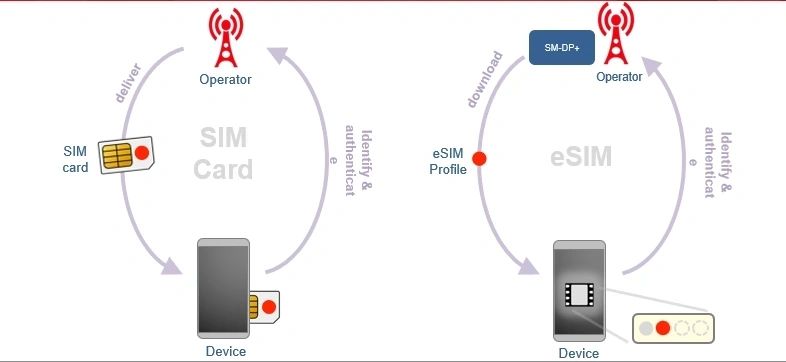
The eSIM vs. SIM ecosystem comparison highlights key differences between traditional SIM cards and embedded SIM (eSIM) technology

Global Trends and Developments
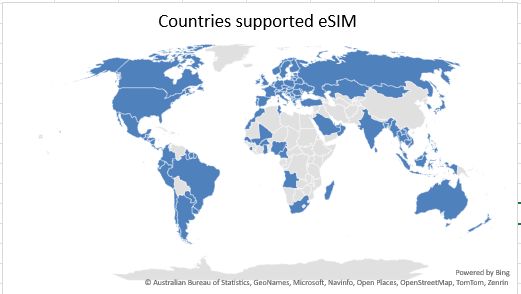
Based GSMA, the following major regions and countries:
- North America
- Most of South America
- Most of Europe
- Russia
- Australia
- Parts of Africa
- Parts of Asia

Roadmap for the development and adoption of eSIM technology, divided into four phases:
· 2013-2017 Laying the foundation This initial phase involved the development of eSIM technology standards and early implementation efforts.
· 2018-2021 Early take-up This phase represents the beginning of eSIM adoption in consumer devices and initial market penetration.
· 2022-2023 Acceleration During these years, the adoption and implementation of eSIM technology appears to have increased rapidly.
· 2024-2026 Scale This final phase suggests a projected period of widespread adoption and large-scale implementation of eSIM technology across various devices and markets.


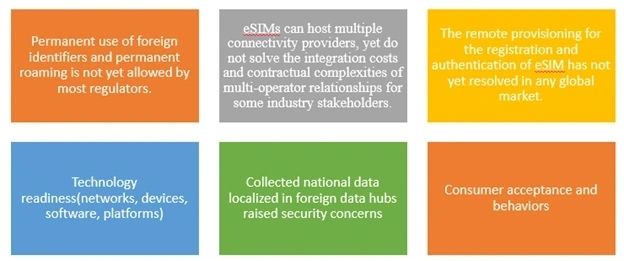
Key challenges to eSIM adoption
Conclusion
The rise of eSIM technology marks a significant shift in mobile connectivity, offering numerous advantages over traditional physical SIM cards. As we’ve seen, eSIMs provide greater flexibility, convenience, and efficiency for both consumers and service providers. The technology’s ability to store multiple profiles, enable remote provisioning, and save space in devices makes it particularly well-suited for our increasingly connected world.
The transition to eSIM technology represents not just a change in how we connect our devices, but a broader shift towards more flexible, efficient, and user-friendly mobile experiences. As the technology continues to mature and gain widespread acceptance, it has the potential to reshape the landscape of mobile communications and device design in the years to come.
Data Sources:
GSMA eSIM: State of the consumer market and the road ahead
GSMA Scaling eSIM in 2023 and beyond
CCS Insight eSIM Poised to Be Next Mobile Industry Disrupter
Meduim The Regulatory Landscape: eSIM and Its Impact on Telecom Regulations


 Telecom Analysis
Leave a comment