

By: Alfredo Calderón
The Internet Corporation for Assigned Names and Numbers (ICANN) is critical to the stability, security, and global coordination of the internet’s Domain Name System (DNS). If you are a newcomer to an ICANN meeting, say ICANN82, you might be asking yourself how you can stay engaged and add value to the ICANN community.
With its multistakeholder model, ICANN thrives on contributions from a diverse range of voices—among which are policymakers, technical experts, cybersecurity professionals, educators, and digital rights advocates. Whether your expertise is in policymaking, security, regional outreach, or internet governance research, ICANN has a place for you. The following is based on my experience getting involved as serve as a volunteer.
Step 1: Determining Your Areas of Interest
Prior to jumping into ICANN’s many groups and committees, take a moment to think about your own interests, areas of expertise, and strengths. Ask yourself the following questions:
1. Are you interested in developing internet governance policies? If so, you may be interested in policy development within ICANN’s Generic Names Supporting Organization (GNSO).
2. Are you experienced in AI or cybersecurity? If so, the Security and Stability Advisory Committee (SSAC) may be the best fit for your technical expertise.
3. Are you a supporter of internet access and digital rights? The At-Large Advisory Committee (ALAC) represents internet users and digital inclusion.
4. Would you like to help boost North American representation in ICANN? By joining NARALO (North America Regional At-Large Organization), you can help make regional voices heard in global forums.
By knowing where your interests and the mission of ICANN intersect, you can direct your participation where you can make a meaningful difference.
Step 2: Discovering ICANN’s Structures and Groups
ICANN has a few Supporting Organizations (SOs) and Advisory Committees (ACs) that address various topics of internet governance. Following is table of the principal groups and the subjects they address:
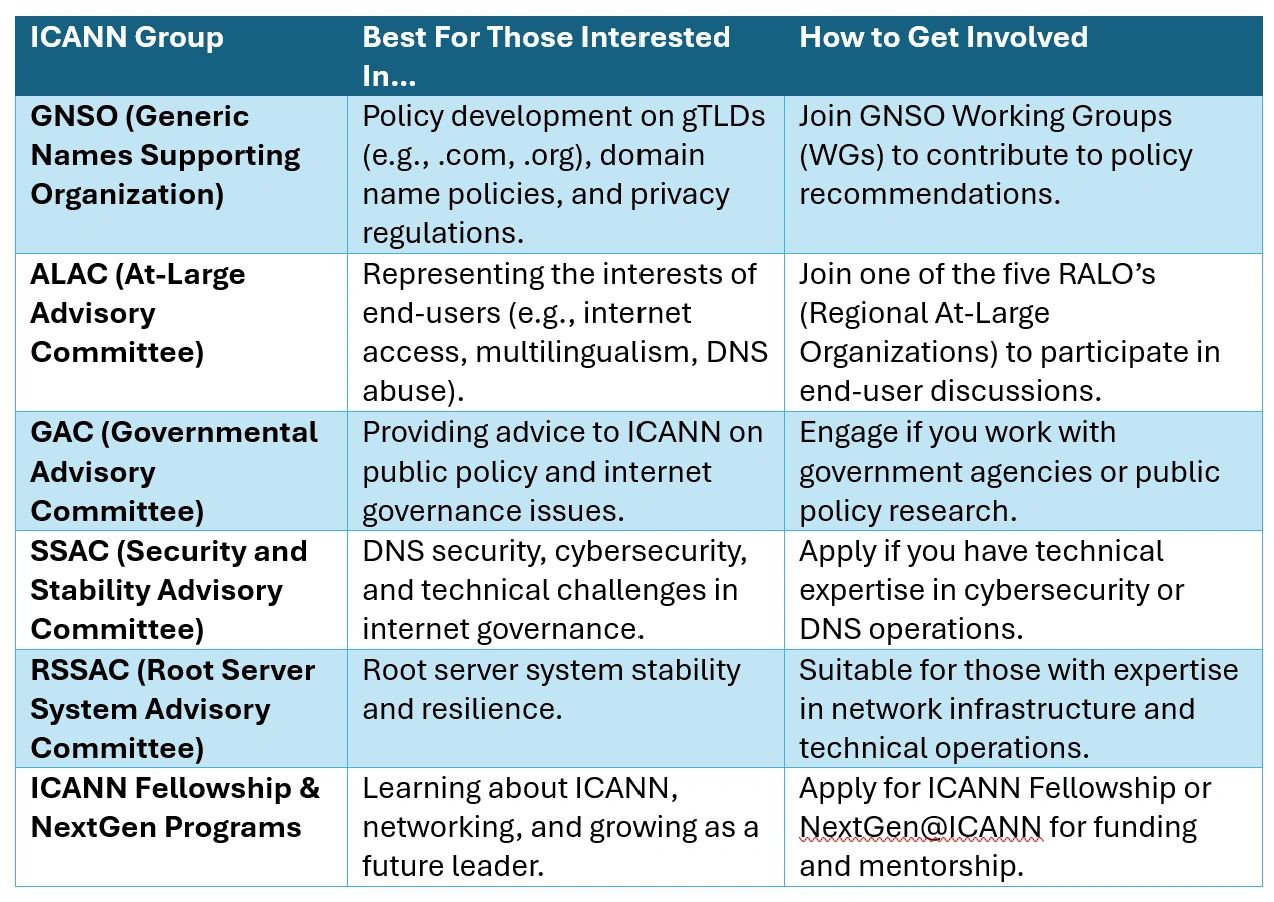
By joining an interest group that reflects your interests, you can engage more in discussions, policymaking, and research that define the future of the internet.
Step 3: Involvement in Policy Development and Discussion
The best thing you can do is to get involved in ICANN’s policy-making process. Here is how you may do it:
- Join a Working Group – ICANN’s decisions are mostly influenced by Working Groups (WGs) within the GNSO, ALAC, and SSAC. These panels debate and provide policy regarding the domain name system of the internet.
- Participate in Public Consultations – ICANN usually opens its policy proposals for comment by the global community via public comment periods. Commenting with your input can have a direct impact on ICANN’s policymaking.
- Participate in Mailing Lists and Webinars – Keeping track of ICANN’s ongoing discussions through newsletters, mailing lists, and webinars online keeps you updated and engaged.
- Participate in Upcoming ICANN Meetings – ICANN hosts three significant meetings every year, along with regional meetings and forums. Attending these meetings provides an opportunity to interact with decision-makers, policymakers, and subject-matter experts in the field.
Step 4: Making a Strategic Contribution
If you have a background in cybersecurity, AI, or education, there are even more specialized ways to contribute:
- Cybersecurity & DNS Stability – Collaborate with SSAC on reports covering DNS security threats, phishing, and other cyber-attacks.
- AI & Internet Governance – Investigate AI’s influence on domain name administration and provide input on responsible AI governance. Education & Capacity Building – Assist ICANN in creating training programs to inform new stakeholders of the significance of the DNS ecosystem, especially in underserved communities such as Latin America and the Caribbean.
- Policy & Research – Carry out research on privacy law, data governance, and developing issues in the ICANN policy environment.
By aligning your knowledge with ICANN’s needs, you are able to position yourself as a thought leader within the international internet governance community.
Step 5: Doing Something Today
If you are prepared to advance your ICANN experience to the subsequent stage, the following are actions you can take right away:
- Identify your area of interest – Select a working group or theme that best suits your experience.
- Subscribe to an ICANN mailing list – Keep abreast of current discussions. Become a member of a regional At-Large organization (RALO) – If you’re from the Latin American or Caribbean region, join LACRALO to be a part of regional advocacy.
- Attend an ICANN webinar or event – Get involved and find out about future projects.
- Apply for ICANN’s Fellowship Program or NextGen – If you’re a newcomer to ICANN, these programs offer sponsorship and mentorship to attend.
Your Voice is Important for Internet Governance ICANN’s strengthening its multistakeholder model, where various stakeholders’ inputs guide policy that impacts the internet globally. No matter if you are a policy analyst, cybersecurity scientist, digital rights activist, or educator, your voice matters. By participating in ICANN’s working groups, public forums, and regional events, you are helping keep the internet open, safe, and accessible to everyone.
Now is the time to come forward and make your voice count. Will you help shape the future governance of the internet?
About the Author
Alfredo Calderón, MA.Ed, is a consultant in Distance Learning and integration of technology in learning environments.
Worked with various higher education institutions in Puerto Rico to redesign academic programs from a traditional to a blended or online format. Chemistry professor at University of Puerto Rico, Mayagüez and Ponce Campus for 20 years. As adjunct professor at Sacred Heart University, Carlos Albizu University, Central University of Bayamón, Universidad Central del Caribe, among others.
Master’s degree in Curriculum & Teaching, master’s degree in Instructional Systems & Instructional Design from Pontifical Catholic University of Puerto Rico and Sacred Heart University, respectively. Undergraduate and graduate studies in Chemistry from University of Puerto Rico, Mayagüez Campus.
Certified as Instructional Designer and Trainer in Blackboard from Spectrum Pacific Learning Company LLC in San Diego, California. With additional certifications from: VNU Learning in e-Learning Design, and Friesen, Kaye and Associates in e-Courses Design.
Certiified by Instituto Latinoamericano y del Caribe de Calidad en Educación Superior a Distancia, Evaluation of Virtual Courses.
Fellowships from:
- Jane N. Ryland Foundation in 2003 & 2006 (Leadership in Distance Education and Program Management)
- U.S.A. National Library of Medicine Fellow 2001 for an internship in Medical Informatics at the Marine Biological Laboratory, in Woods Hole, Massachusetts.
- ICANN60, ICANN62 & ICANN63 Fellow, ARIN 38 & ARIN 39 Fellow.
Volunteer in various Working Groups in ICANN and At-Large Organizations since 2015, after participating in ICANN53 in Buenos Aires, Argentina. Member of Board of the Internet Society – Puerto Rico Chapter. Past member of the ICANN Fellowship Selection Committee and currently, an ICANN At-Large Fellowship Mentor (2-term).
On the organizing team for NASIG2018 & NASIG2019. Since September 2020, co-founder and managing the Virtual School of Internet Governance (VSIG).
Executive Director or Chair of the Center of Academic Resources or Information Systems in various universities in Puerto Rico.


 Telecom Analysis
Leave a comment