

By Rolla Hassan, Ph.D
Introduction
IMT-2030 aims to build on previous generations of mobile networks (IMT-2000, IMT-Advanced, IMT-2020) while introducing new capabilities to support emerging use cases and technologies.
Key motivations for IMT-2030 include inclusivity, ubiquitous connectivity, sustainability, innovation, enhanced security/resilience, and standardization/interoperability.
Major technology trends expected to shape IMT-2030 include:
- Ubiquitous intelligence/AI integration
- Immersive multimedia and multi-sensory interactions
- Digital twins and virtual worlds
- Smart industrial applications
- Integration of sensing and communication

There are Six main usage scenarios are outlined for IMT-2030:
- Immersive Communication (evolution of enhanced Mobile Broadband)
- Hyper Reliable and Low-Latency Communication
- Massive Communication (evolution of massive Machine Type Communication)
- Ubiquitous Connectivity
- Artificial Intelligence and Communication
- Integrated Sensing and Communication
- Key capabilities targeted for IMT-2030 include:
- Peak data rates up to 50-200 Gbps
- User experienced data rates of 300-500 Mbps
- Latency of 0.1-1 ms
- Connection density of 10^6 – 10^8 devices/km2
- Positioning accuracy of 1-10 cm
ITU WP 5D Timeline for IMT-2030
ITU Working Party 5D (WP 5D) is a key group within the International Telecommunication Union (ITU) that focuses on the development of International Mobile Telecommunications (IMT) systems.
timeline for the development of IMT-2030 (International Mobile Telecommunications-2030) from 2021 to 2030. The timeline is divided into years, with key milestones and activities marked throughout.
Key elements of the timeline include:
- Regular meetings (labeled 5D #37 through #63) occurring multiple times each year.
- Major reports and recommendations, such as:
- ITU Report on new Future Technology Trends (2021-2022)
- Recommendation on a new Framework of IMT-2030 (2022-2023)
- Report on IMT feasibility above 100GHz (2022-2024)
- Technical development phases:
- Technical performance requirements (2024-2025)
- Evaluation criteria & methodology (2025-2026)
- Technology Proposals for IMT-2030 (2027-2028)
- Evaluation and Consensus building (2028-2030)
- Two World Radiocommunication Conferences (WRC-23 and WRC-27) marked in 2023 and 2027.
- A workshop planned for 2026.
- The final outcomes in 2030, including “Outcome & decision” and “IMT-2030 specifications”.
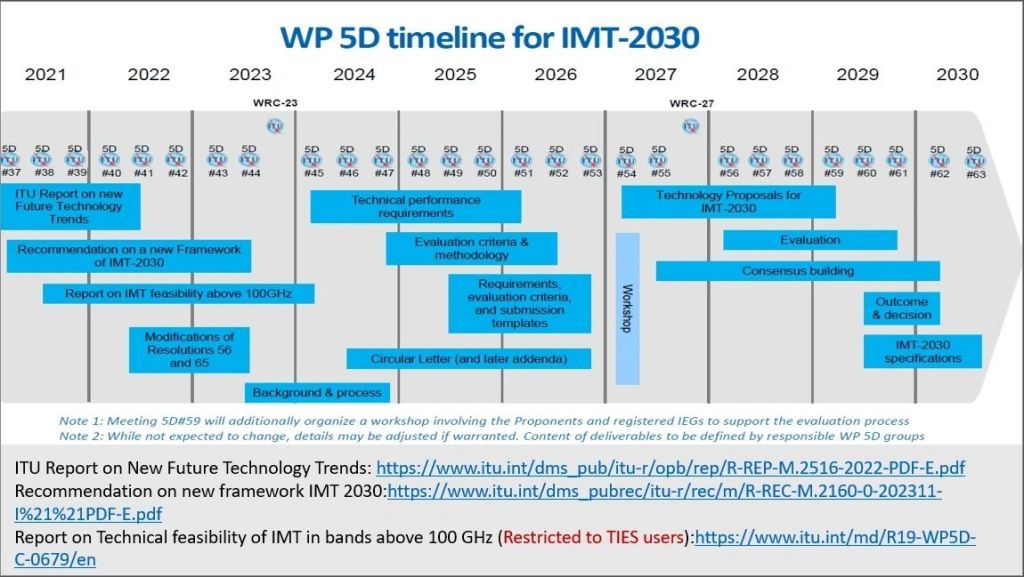
he timeline targets initial standardization by 2030 to enable deployments from 2030 onwards.
The report encourages research to focus on areas like:
- radio interface(s) standards development;
- access network-related issues;
- traffic characteristics;
- spectrum-related issues.
Data Sources
ITU Recommendation ITU-R M.2160-0 https://www.itu.int/dms_pubrec/itu-r/rec/m/R-REC-M.2160-0-202311-I%21%21PDF-E.pdf
ITU Future technology trends of terrestrial International Mobile Telecommunications systems towards 2030 and beyond: https://www.itu.int/dms_pub/itu-r/opb/rep/R-REP-M.2516-2022-PDF-E.pdf
GSA 6G Networks Status Update: https://gsacom.com/paper/6g-networks-status-update/


 Telecom Analysis
Leave a comment