

By: Geoffrey Myers
Competition assessment is an integral component of well-designed spectrum auctions, yet around the world important considerations are often omitted, as I explain in my open-access book, Spectrum Auctions: Designing markets to benefit the public, industry and the economy. Licences for the rights to use the mainstream spectrum frequency bands which are incorporated into the most popular smartphones, such as Apple’s iPhone and Samsung’s Galaxy, are key strategic assets for mobile phone companies. It is now common practice worldwide for regulators to deploy auctions in order to award these licences. Auctions can work out broadly as expected, be highly successful, or go embarrassingly wrong. This applies in both developing and developed countries, where the regulators designing and running the auctions face different circumstances and are characterised by varying degrees of institutional strength.
When deciding how best to design auctions to award these scarce resources, regulators should consider the downstream consequences for competition and consumers. What ultimately matters is how well consumers are served by competition in mobile markets in the short and long run through prices, quality, choice, and innovation. At issue here are the effects at two market levels where vertically-integrated mobile operators are present: how outcomes in the upstream auction market affect operators’ spectrum portfolios, and how those in turn impact on the outcomes in downstream markets for services sold to consumers.
The UK has historically had a relatively competitive mobile market. One success factor has been sustaining a consistent approach to promoting competition through both the spectrum management policy of the regulator (Ofcom) and merger assessment by the competition agencies (and at time of writing the Competition and Markets Authority is scrutinisinga proposed merger between two of the four UK mobile operators, Vodafone and CK Hutchison).
Another contributor to success has been carefully considered and proportionate competition measures in auctions to promote vigorous downstream competition, such as spectrum caps to limit the concentration of spectrum holdings or reservation (set-aside) for new entrants. Competition measures are usually highly contentious with the industry, because operators have divergent interests. Based on my experience at Ofcom, I argue for the application of a structured framework to assist evidence-based competition analysis comprising three steps – see Figure 1:
· Step 1 identifies the risk of downstream market failure occurring after the auction, due to the allocation of spectrum in the auction leading to a weakening in competition by affecting the number of operators or reducing the strength of competition between them.
· Step 2 assesses possible upstreammarket failure – the risk that the worrying outcomes identified in step 1 occur in the auction. For example, by considering the ability and incentive of one or more operators to engage in either unilateral or coordinated foreclosure (so-called ‘strategic investment’ of buying additional spectrum), where the payoff comes from weakening downstream rivals by preventing them from acquiring the spectrum that they need to be stronger competitors.
· Step 3 judges what effective and proportionate competition measures to impose, paying attention to regulatory failure risks of ineffectiveness and unintended consequences.
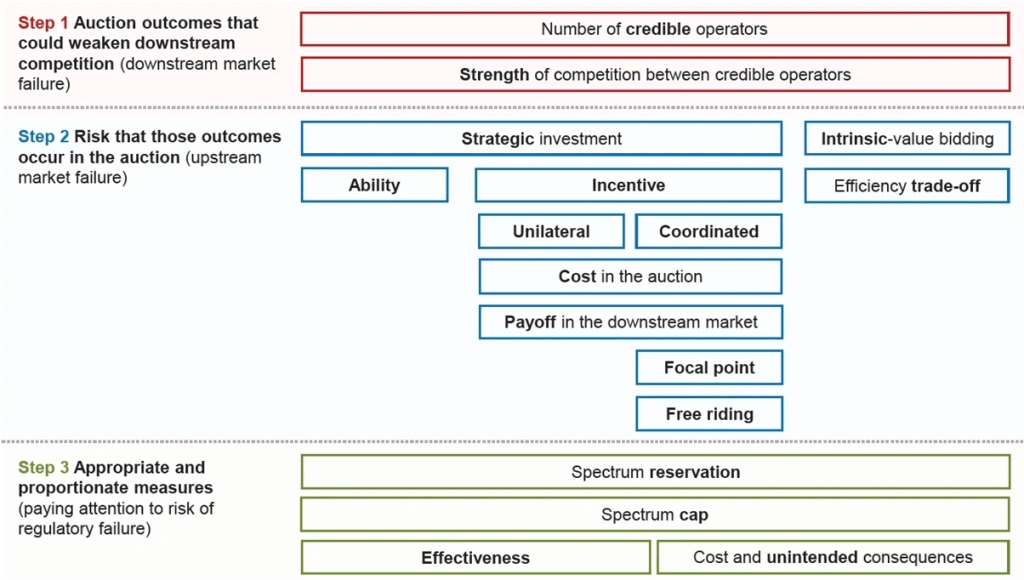
Source: Figure 9.4 in Myers (2023) Spectrum Auctions: Designing markets to benefit the public, industry and the economy
Decisions on competition measures in the UK using this framework have been successful in promoting mobile competition. However, competition assessments in some other countries appear to focus primarily on step 1, which can at times lead regulators to impose measures which are unnecessary, ineffective or disproportionately restrictive. Steps 2 and 3 of the framework help to clarify what is at stake and the benefits from imposing the competition measures relative to the costs. These steps can mitigate a potential failing from more limiting competition measures than necessary, which risk distorting the auction outcomes in the upstream spectrum market for the industry and in the downstream retail market for the public. Overall, the three-step analytical framework assists the regulator to include relevant considerations and to apply consistent, structured judgement, while also guarding against adopting ineffective or unduly restrictive competition measures.
In addition, my book sets out a variety of further tailored analytical frameworks, covering the many other decisions that a regulator needs to make when designing the auction rules and the market infrastructure to achieve successful spectrum auctions.
About The Author

Geoffrey Myers is Visiting Professor in Practice, London School of Economics and Political Science, and formerly Director of Competition Economics at Ofcom, 2003-21. His 2023 book, Spectrum Auctions: Designing markets to benefit the public, industry and the economy, is published by LSE Press and can be downloaded for free at https://doi.org/10.31389/lsepress.spa.


 Telecom Analysis
Leave a comment