

By Rolla Hassan, Ph.D
The latest GSA report is the latest edition in a continuous series that summarizes market trends, utilizing data gathered from GSA’s extensive databases on chipsets, devices, spectrum, and networks. Telecom Analysis conducted further research on the trends and implications of Sub-6 GHz frequency support in the 5G SA ecosystem. This in-depth review brings additional insights into the growing demand and deployment of 5G Standalone
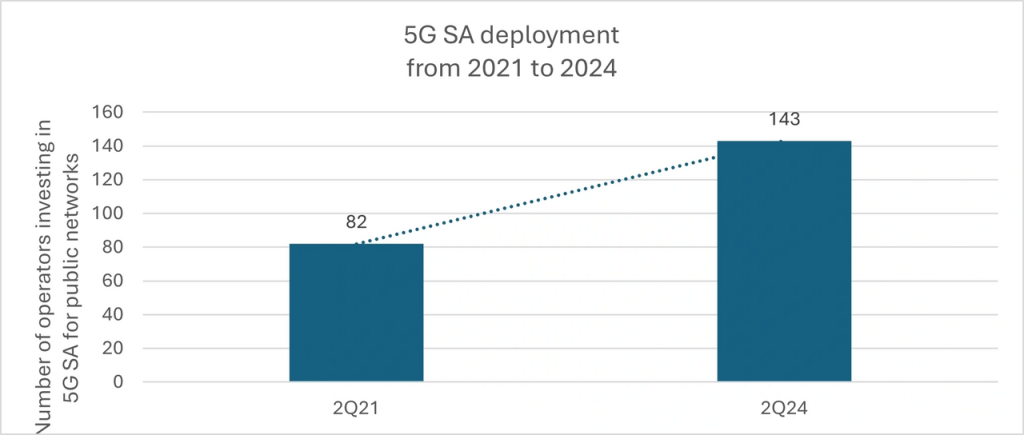
GSA has identified 143 operators in 61 countries and territories worldwide that have been investing in public 5G SA networks through trials, planned or actual deployments
In 2Q21, approximately 80 operators were investing in 5G SA. By 2Q24, this number is projected to increase to about 140 operators. This represents a growth of around 75% over the three years. The dotted line represents the trend between the two data points suggesting a steady, linear increase in 5G SA investments over this period.
This graph shows the number of operators with launched 5G SA (Stand Alone) networks by region from 2020 to 2024 YTD (Year To Date). The overall trend is there was a significant increase in 5G SA network launches from 2020 to 2022, peaking at 17 total launches in 2022. After 2022, there’s been a slight decline, with 15 launches in 2023 and only 5 so far in 2024.
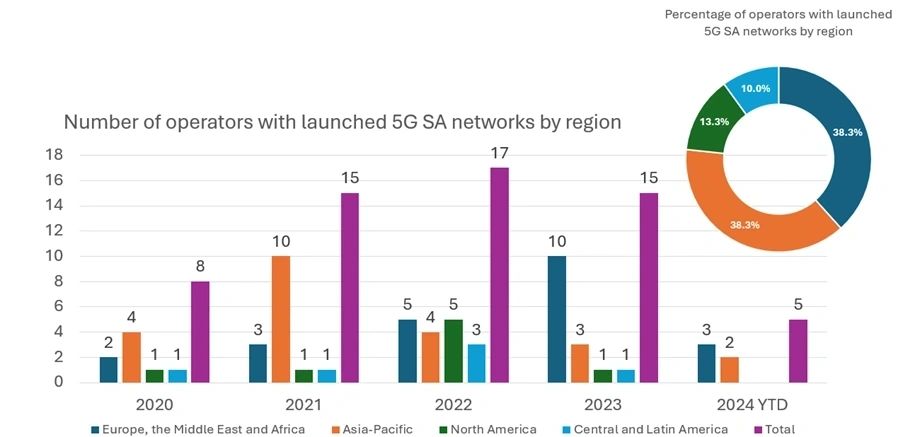
There is indeed a notable variance between the operators investing in 5G SA technology and those that have actually launched 5G SA networks.
Operators Investing in 5G SA:
- As of the report’s date, 143 operators in 61 countries and territories worldwide have been investing in public 5G SA networks.
- This investment includes trials, planned deployments, and actual deployments.
- The number of operators investing is projected to grow from about 80 in 2Q21 to around 140 in 2Q24, representing a 75% increase.
Operators with Launched 5G SA Networks:
- The number of operators that have actually launched 5G SA networks is significantly lower.
- The peak number of launches was 17 in 2022.
- In 2023, there were 15 launches, and only 5 so far in 2024 (YTD).
Highlighting the Variance:
- While 143 operators are investing in 5G SA, the number of actual launches per year has not exceeded 17.
- This suggests a large gap between those planning or trialing 5G SA and those who have fully deployed it.
- The investment trend is showing steady growth, but the launch numbers have plateaued and even slightly declined after 2022.
Spectrum Support in Devices
The Sub-6 GHz frequency bands are becoming increasingly well-supported in 5G Standalone (SA) devices. This is evident from the large number of devices supporting mid-band frequencies like 3500 MHz (n78), 2500 MHz (n41), and 2100 MHz (n1), as well as the rising support for lower frequencies like 700 MHz (n28) and 600 MHz (n71). These frequencies offer a blend of coverage, capacity, and indoor penetration, making them critical for the broad deployment and success of 5G networks.
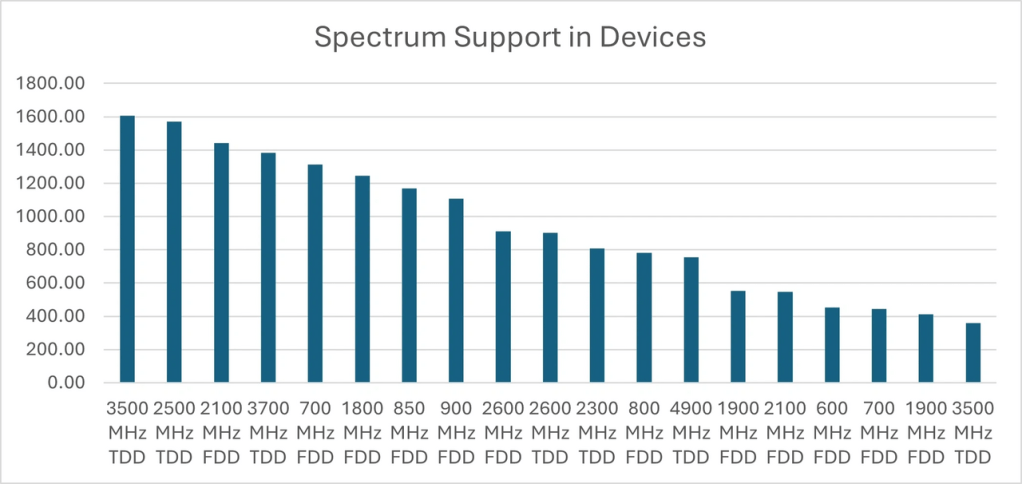
Data Source: https://gsacom.com/paper/5g-standalone-september-2024/


 Telecom Analysis
Leave a comment