

By: Rolla Hassan Ph.D
Introduction
The radio spectrum is a finite and increasingly precious resource. As global demand for high-speed mobile data explodes, driven by 5G and the roadmap to 6G, the technical and regulatory challenge of coexistence in the 6–15 GHz range has become the latest hot topic in spectrum management.
This debate centers on how to introduce new, bandwidth-hungry wireless services without crippling the essential, often overlooked, infrastructure that keeps our current networks running.
Coexistence of other radio services in parts of the 6–15 GHz range is the latest hot topic in spectrum.
Coexistence in 6–15 GHz
Spectrum scarcity has elevated the need for sharing and coexistence to a critical priority. Driven by the massive data demands of 5G/6G, advanced Wi-Fi, satellite, and wireless backhaul, opportunities within the 6–15 GHz range have become the central focus of global backhaul spectrum policy.
Access is secured either through global consensus via the ITU’s World Radiocommunication Conferences (WRC), or through regional and national decisions. In either case, harmonization—standardizing frequency bands and technical rules—is paramount. This standardization is key to unlocking economies of scale, providing substantial benefits to the entire telecom ecosystem.
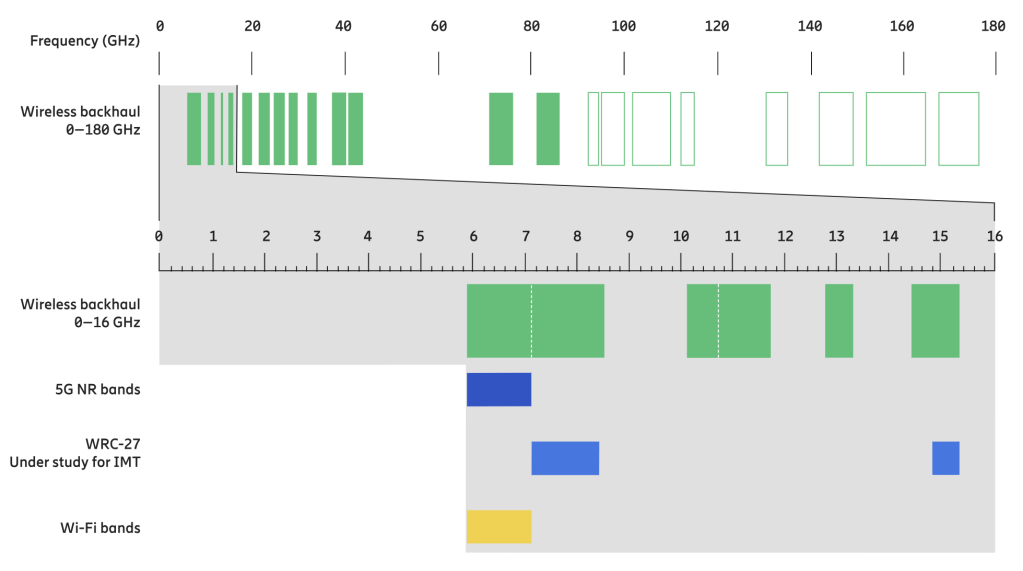
The most intense regulatory conflict is centered on the 6 GHz band. Some administrations have allocated the lower segment (5.925–6.425 GHz) for unlicensed use, including Wi-Fi and 5G NR-U. A few, like the U.S., have expanded this allocation up to 7.125 GHz.
Introducing these license-exempt services into a band historically dominated by licensed, fixed wireless backhaul raises serious concerns. Despite new technical conditions designed to protect incumbent backhaul, debate continues over whether protection is sufficient against aggregate interference—especially considering “bursty” interference from Wi-Fi beacon signals. Given the uncontrolled nature of unlicensed spectrum, how interference issues will be resolved in practice remains one of the greatest open questions for regulators.
Source: Ericsson (2024)
Fixed Links (Microwave Backhaul)
The 6–15 GHz bands are the backbone of global mobile networks. These frequencies are predominantly utilized by Fixed Links (Microwave Backhaul), which are point-to-point connections that link cell sites to the core network.
According to the Ericsson Microwave Outlook 2024 report, the traditional 6–42 GHz range remains critical, with the 6–8 GHz bands being essential for long-range wireless backhaul—links that span 20 km to over 100 km, particularly in rural and semi-rural areas. The 10–15 GHz bands support similar functions over shorter distances, closer to urban centers.
This infrastructure is vital because fiber is often too costly or impractical to deploy in every location. To ensure the reliability of 5G and future networks, the performance and protection of these incumbent licensed links must be maintained.
The 6 GHz Collision: Licensed vs. Unlicensed
The most contentious area is the 6 GHz band (5.925–7.125 GHz). Different regulatory bodies have adopted varying approaches, creating a complex coexistence landscape.
- The Unlicensed Threat (Wi-Fi): Countries like the United States have allocated the entire 6 GHz band for unlicensed use, primarily for Wi-Fi 6E/7 and 5G NR-U. While technical mitigation conditions (like Low Power Indoor operation) are established to protect licensed backhaul, this move raises significant concerns.
- The Interference Risk: The debate is whether backhaul is adequately protected in worst-case scenarios, especially from aggregate interference caused by the sheer volume of new Wi-Fi devices. Spectrum managers are also studying the impact of bursty interference, such as Wi-Fi beacon signals, on the highly sensitive point-to-point links. Interference here can jeopardize the transport network, which is the foundation of the mobile service.
- The Licensed Opportunity (IMT/5G): In contrast to unlicensed use, the introduction of licensed International Mobile Telecommunications (IMT) services—the generic term for technologies like 5G—is viewed as less challenging for coexistence.
Coordination is Key: Licensed systems are deployed in known, fixed locations and employ features like narrow-beam antennas and Automatic Transmit Power Control (ATPC). Crucially, their licensed nature allows for geographical and technical coordination with existing backhaul links, making harmonious sharing a viable objective. This distinction is paramount in the regulatory environment.
The Global Regulatory Roadmap
The International Telecommunication Union (ITU) is actively addressing these coexistence challenges:
WRC-23 Outcome: The World Radiocommunication Conference (WRC-23) decided on the international harmonization of the upper 6 GHz spectrum (6.425–7.125 GHz) for IMT in many regions, a step toward global economies of scale for mobile equipment.
WRC-27 Studies: The agenda for the 2027 conference (WRC-27) includes studies on sharing and compatibility for IMT in other existing backhaul bands, specifically parts of the 7.125–8.4 GHz and 14.8–15.35 GHz ranges.
Conclusion: The Spectrum Balancing Act
The ultimate challenge for national regulators is to precisely balance the economic and social benefits derived from new spectrum access (whether licensed or unlicensed) against the need to protect current, vital infrastructure (like fixed backhaul links).
Effective spectrum policy hinges on establishing technical conditions that maximize overall utilization of the 6–15 GHz range while minimizing harmful interference across all technologies—be they mobile (IMT), unlicensed Wi-Fi, or incumbent microwave. The future success of global mobile transport and the growth of high-speed wireless broadband depends entirely on making data-driven, harmonized regulatory decisions that secure reliability for essential services and enable innovation for new entrants.
Source: Spectrum – A shared gem: Ericsson Microwave Outlook 2024


 Telecom Analysis
Leave a comment