

By: Rolla Hassan Ph.D
Key Market Statistics
| Global MVNO subscribers by 2030 | 438 million |
| Total MVNO revenue by 2030 | $54.4 billion |
| MVNO-in-a-Box market by 2030 | $1.9 billion |
| MVNO subscriber share of mobile market (2030) | 4.2% |
| UK MVNO share of connections (end-2024) | 19.7% |
Introduction
The global mobile landscape is undergoing a quiet revolution. While major Mobile Network Operators (MNOs) have long dominated the telecommunications industry, a new breed of agile, innovative, and customer-centric players is rapidly gaining ground. These are the Mobile Virtual Network Operators (MVNOs), and they are fundamentally reshaping how mobile services are delivered and consumed. With a projected 438 million subscribers by 2030, the MVNO market is no longer a niche segment but a significant force driving competition, innovation, and new revenue streams in the global telecommunications industry.
An MVNO is a wireless service provider that does not own the physical cellular network infrastructure, such as cell towers and radio spectrum licenses. Instead, it leases network access from traditional MNOs at wholesale rates and resells it to consumers under its own brand. This decoupling of the service layer from the infrastructure layer allows MVNOs to focus on creating differentiated offerings, targeting specific market segments, and fostering competition in regions often dominated by a few large telecom operators. By avoiding the substantial capital expenditure of building and maintaining a physical network, MVNOs can offer more competitive pricing or specialized plans that address the unique needs of their customers.
This article provides a comprehensive deep-dive into the world of MVNOs, exploring the market dynamics, business models, and technological enablers that are fueling their growth. We will analyze the value proposition for both consumers and enterprises, examine the new wave of market entrants from the fintech and retail sectors, and discuss the challenges and opportunities that lie ahead. From the rise of eSIMs and cloud-native platforms to the impact of 5G and the Internet of Things (IoT), we will uncover how MVNOs are not just surviving but thriving in the ever-evolving telecom landscape.
The MVNO Landscape: A Market Overview
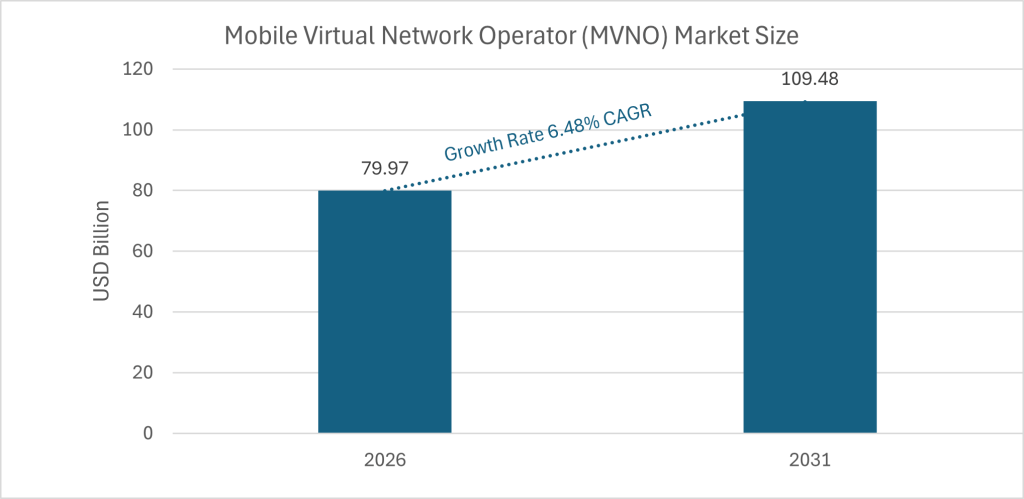
The MVNO market is experiencing a period of sustained and robust growth, outpacing the broader mobile market and demonstrating its increasing importance in the global telecommunications ecosystem. The market is projected to grow from USD 79.97 billion in 2026 to USD 109.48 billion by 2031, at a compound annual growth rate (CAGR) of 6.48%. This expansion is driven by a confluence of factors, including the rise of cloud-based enablement platforms, the proliferation of eSIM technology, and the growing demand for specialized and cost-effective mobile services.
Globally, the number of MVNO subscribers is set to increase from 333 million in 2026 to 438 million in 2030, an increase of over 31%. This growth is not evenly distributed, with different regions exhibiting unique market dynamics.
Europe represents a mature and highly competitive MVNO market. The United Kingdom, in particular, has a strong MVNO presence, with virtual operators accounting for 19.7% of all mobile connections at the end of 2024, a significant increase from 14.9% at the end of 2021. In 2024 alone, the number of UK MVNO customers grew by 9.8%, compared to just 0.7% for the market as a whole, highlighting the strong consumer appetite for alternative mobile providers.
North America, particularly the United States, presents a more complex picture. While the market has seen the emergence of high-profile MVNOs, it is also characterized by regulatory challenges and concerns about market consolidation. The acquisition of MVNOs by MNOs, such as T-Mobile’s purchase of Mint Mobile, and the regulatory hurdles faced by new entrants, underscore the competitive pressures in the US market.
Asia-Pacific is poised to be the fastest-growing region for MVNOs, with a projected CAGR of 7.45% through 2031. This growth is fueled by a combination of factors, including increasing mobile penetration, a large and diverse consumer base, and a growing demand for digital services. However, the region also presents challenges, as illustrated by the collapse of the MVNO market in Thailand due to regulatory failures and the resistance of MNOs to provide wholesale access.
Key Growth Drivers for the MVNO Market
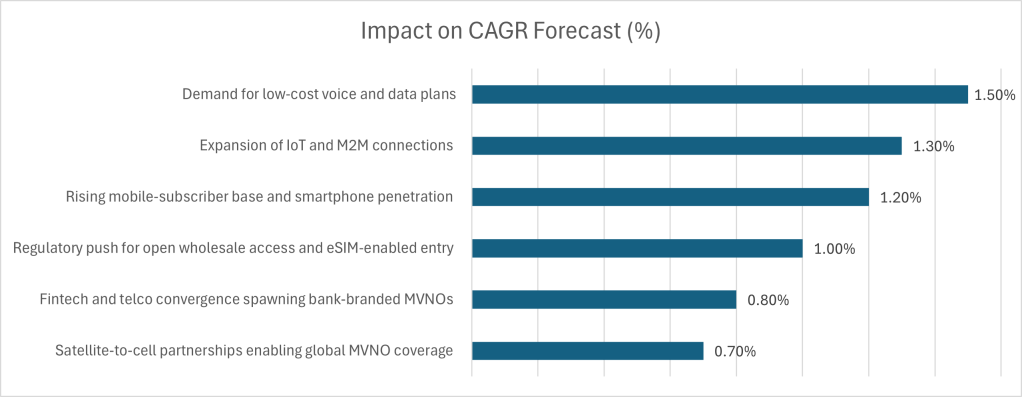
Rising Smartphone Penetration & Data Consumption
India and Sub-Saharan Africa are experiencing explosive smartphone growth, with India adding over 100 million new users between 2024-2025 and Sub-Saharan Africa surpassing 50% urban smartphone adoption for the first time in 2025. This enlarged user base drives higher data consumption as customers engage with video streaming, social commerce, and digital wallets. MVNOs benefit significantly from this trend because cloud-based billing systems allow them to rapidly bundle services and adjust pricing without costly network upgrades. Additionally, higher data usage reduces customer churn as subscribers become locked into app ecosystems tied to their MVNO accounts rather than relying solely on traditional voice services.
Price Arbitrage Opportunities in Emerging Markets
Economic pressures are creating demand for affordable alternatives to traditional carriers. Brazil’s 4.6% inflation rate in 2025 has pushed middle-income consumers toward prepaid MVNO plans priced 30-40% below incumbent post-paid offerings. Similarly, European wholesale gigabyte fees fell 12% between 2023 and 2025, enabling discount MVNOs to maintain gross margins above 20% while undercutting MNO retail prices. However, this arbitrage window is narrowing as host MNOs deploy fighter brands and regulators implement price floors to protect network investment returns, suggesting that long-term MVNO success will require differentiation beyond price competition.
IoT and M2M as a Stable Revenue Anchor
The cellular IoT market is experiencing exponential growth, with 3.2 billion connections globally in 2025 projected to reach 5.5 billion by 2030. Logistics, utilities, and healthcare providers are increasingly adopting MVNO-aggregated global SIMs to consolidate contracts across multiple countries. IoT connections are particularly valuable for MVNOs because they generate annuity-like revenue with predictable usage patterns over 10-15 year device lifecycles, providing a counterbalance to the volatility of consumer prepaid markets. This stable revenue stream also justifies investments in cloud-native core networks optimized for narrowband, low-power IoT devices.
Regulatory Enablement Through Wholesale Access & eSIM Interoperability
Regulatory frameworks are actively lowering barriers to MVNO entry. The European regulatory body BEREC mandated that MNOs grant full MVNO access within 90 days of request (effective 2024), dramatically reducing time-to-market for new entrants. India’s telecom regulator (TRAI) introduced eSIM interoperability in 2025, allowing consumers to switch operators without visiting physical stores. These regulatory changes enable fintechs and content platforms to embed connectivity directly into their apps with minimal friction, intensifying competition while simultaneously spurring service innovation across the industry.
Deconstructing the MVNO Model
The MVNO landscape is not monolithic. Over the years, a variety of operational models have emerged, each offering a different balance of control, investment, and service differentiation. Understanding these models is crucial for appreciating the strategic choices available to companies entering the MVNO space.
The evolution of MVNOs can be seen as a spectrum, ranging from simple brand resellers to full-fledged operators with their own core network infrastructure. The primary models include:
- Branded Reseller: This is the simplest form of MVNO, with the least control over operations and infrastructure. Branded resellers primarily focus on marketing, sales, and their own branding, while the host MNO manages all technical aspects, including the network, billing, and SIM card distribution.
- Service Provider MVNO: This model offers a greater degree of control than a branded reseller. Service Provider MVNOs manage their own billing, customer care, and sales, but still rely on the host MNO for core network operations and maintenance.
- Light MVNO: Light MVNOs take a step further by managing more of their own infrastructure, but they still depend on the MNO for certain core network functions. They might handle their own billing, customer care, and SIM card distribution, but utilize the MNO’s radio access network (RAN) and parts of the core network.
- Full MVNO: This is the most advanced and complex model. A Full MVNO has the highest level of control, short of owning the physical radio network. They operate their own core network infrastructure, which allows them to have full control over their services, including SIM card production, service design, and customer management. They only rely on the MNO for the radio access network.
| MVNO Model | Infrastructure Ownership | Control over Services | Key Responsibilities | Example Use Case |
|---|---|---|---|---|
| Branded Reseller | None | Low | Marketing, Sales, Brand | A retail chain offering a co-branded mobile plan |
| Service Provider | None | Medium | Billing, Customer Care, Sales, Brand | A company targeting a specific niche with tailored plans. |
| Light MVNO | Some (e.g., billing systems) | High | Billing, Customer Care, SIMs, Service Innovation | An enterprise wanting to offer integrated mobile services. |
| Full MVNO | Own Core Network | Very High | All aspects except RAN, including network routing & SIMs | A global IoT provider needing full control over connectivity. |
At the heart of the MVNO ecosystem is the Mobile Virtual Network Enabler (MVNE). An MVNE is a company that provides the necessary infrastructure and services to enable other companies to become MVNOs. They act as intermediaries between MNOs and MVNOs, offering a range of services such as billing, customer relationship management (CRM), and network provisioning. MVNEs play a crucial role in lowering the barriers to entry for new MVNOs, providing them with the technical expertise and platforms needed to launch and operate their services.
Understanding the MVNO Ecosystem: Key Players and Their Roles
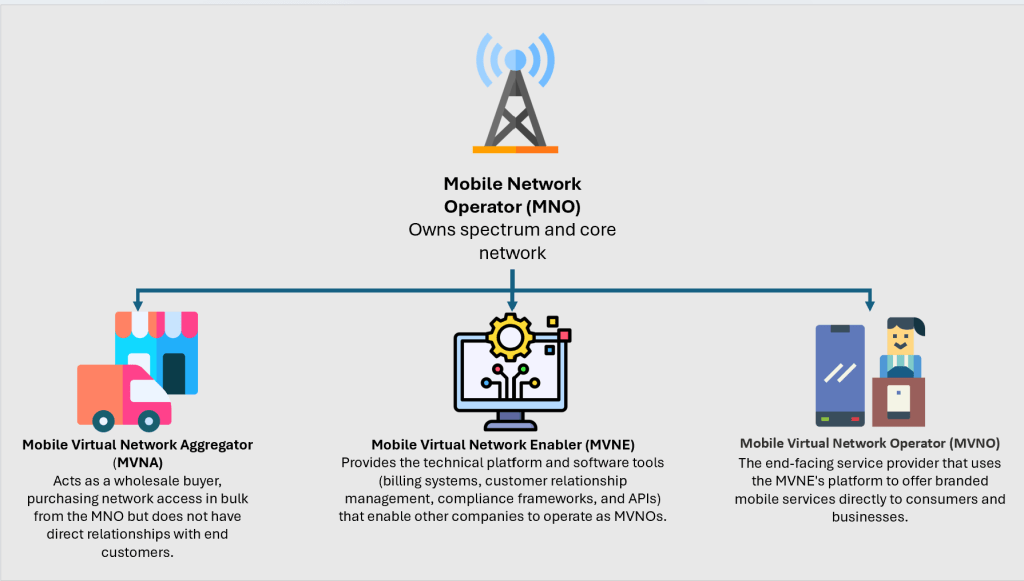
An MNO (Mobile Network Operator) owns and operates the full mobile network — towers, radio spectrum licenses (2G through 5G), billing systems, and customer support. It’s the foundation everything else is built on, and it can sell wholesale network access to other players.
An MVNO (Mobile Virtual Network Operator) sells mobile services without owning any network infrastructure. It buys wholesale access from an MNO and resells it under its own brand, managing its own pricing, customer support, and marketing.
An MVNE (Mobile Virtual Network Enabler) doesn’t sell services to end users at all — instead it provides the backend infrastructure that MVNOs need to operate, such as billing software, SIM management, and customer account tools. It lets MVNOs focus on sales and marketing rather than technical operations.
An MVNA (Mobile Virtual Network Aggregator) acts as a middleman between MNOs and MVNOs, purchasing bulk airtime from MNOs and reselling it to multiple MVNOs — helping smaller operators access network resources at lower costs.
Why MVNOs are Gaining Traction
The rapid growth of the MVNO market can be attributed to the compelling value proposition it offers to a diverse range of stakeholders. By unbundling network infrastructure from service delivery, MVNOs have created a new paradigm in the telecommunications industry, offering distinct advantages to both consumers and enterprises.
For Consumers: A New Era of Choice and Flexibility
For mobile subscribers, the rise of MVNOs has ushered in an era of greater choice, affordability, and personalization. The primary drivers behind consumer adoption of MVNOs include:
- Cost Savings: By leasing network capacity at wholesale rates and maintaining a lean operational structure, MVNOs can offer highly competitive pricing. They often provide more affordable plans compared to major carriers, making them an attractive option for budget-conscious consumers.
- Flexibility: MVNOs are known for their flexible tariff structures and contract terms. They often provide prepaid and no-contract options, appealing to consumers who wish to avoid long-term commitments and restrictive agreements.
- Personalized Services: Unlike MNOs that typically target the mass market, MVNOs can focus on specific customer segments or niches. This allows them to offer tailored plans and services that cater to the unique needs of their target audience, such as international calling packages for expatriates or senior-friendly plans with simplified features.
- Comparable Quality of Service: A crucial factor in the success of MVNOs is the perception that they offer a comparable quality of service to MNOs. Many consumers are not even aware that their mobile service is being provided by an MVNO, which is a testament to the seamless experience they provide.
For Enterprises: A New Frontier for Growth and Innovation
Enterprises across various sectors are increasingly launching their own MVNOs, not just as a new revenue opportunity, but as a strategic tool to enhance their core business. The key motivations for enterprises to enter the MVNO space include:
- Customer Loyalty and Retention: By integrating mobile services into their existing offerings, companies can increase customer dependency and reduce churn. This is particularly effective for businesses with subscription-based models or established customer ecosystems.
- Revenue Diversification and Uplift: Launching an MVNO provides a new revenue stream and diversifies a company’s income sources. Furthermore, by bundling mobile services with their core products, enterprises can create revenue uplift and increase the average revenue per user.
- Brand Differentiation: In markets saturated with homogenous products and services, an MVNO can be a powerful differentiator. It allows a brand to stand out from the competition and offer a unique value proposition to its customers.
- Superapp Strategies: The integration of mobile services is a key component of the superapp strategy, where companies aim to create a single ecosystem that encompasses a wide range of services, from payments and banking to communication and entertainment. Fintech companies, in particular, are leveraging MVNOs to expand their service offerings and create a more holistic customer experience.
The Rise of MVNO-in-a-Box Revolution
The single biggest structural change in the MVNO market is the emergence of what the industry calls ‘MVNO in a box’ — also referred to as Telecom-as-a-Service (TaaS) or MVNO-as-a-Service. Juniper Research defines these as scalable turnkey platforms which simplify MVNO launches for enterprises, minimising launch times and costs. Rather than building out complex back-office systems, negotiating bespoke wholesale agreements, and hiring specialist telecom expertise, a brand can now launch a mobile service with a fraction of the traditional complexity and risk.
US-based platform provider Gigs, founded in 2020, is one of the most prominent examples — underpinning Klarna’s US mobile service and partnering with major MNOs across multiple markets. UK-based eSIM Go similarly offers an automated MVNO-in-a-box platform used by brands including Lufthansa and Western Union. The Juniper Research forecast for this segment alone projects the MVNO-in-a-box market to reach $1.9 billion by 2030.
The rise of eSIM technology has compounded this effect. Unlike physical SIM cards, eSIMs are embedded in devices and can be provisioned remotely, dramatically lowering the cost and complexity of onboarding subscribers. Revolut launched a travel eSIM service in early 2024 before making the full leap to becoming an MVNO. The combination of enabling platforms and eSIM infrastructure has made mobile services a realistic proposition for enterprises that would previously never have considered it.
The New Wave: Fintech, Retail, and the Changing Face of MVNOs
The traditional MVNO market, once dominated by telecom-focused entities, is being reshaped by a new wave of entrants from diverse industries. Fintech firms, retail giants, and even celebrities are now launching their own mobile services, leveraging their existing brand equity and customer bases to disrupt the telecommunications landscape. This trend signifies a fundamental shift in how mobile services are perceived—less as a standalone utility and more as an integrated component of a broader digital lifestyle and business ecosystem.
The Fintech Foray: From Banking to Bandwidth
Fintech companies have been particularly aggressive in the MVNO space since 2024. For these digital-native firms, adding mobile services is a logical extension of their superapp ambitions. By bundling connectivity with their core financial products, they aim to create a stickier, more integrated customer experience, increase revenue per user, and gather valuable data to refine their offerings. The existing Electronic Know Your Customer (eKYC) capabilities of neobanks also give them a significant advantage in onboarding new mobile subscribers seamlessly.
This strategic push has led to a flurry of high-profile launches, transforming the competitive dynamics of both the financial and telecom sectors.
| Fintech/Bank | Country/Region | Launch Year | Host MNO |
|---|---|---|---|
| Revolut | UK, Poland, Germany | 2025 | – |
| Klarna | US, UK, Germany | 2025 | AT&T (US) |
| N26 | Germany | 2025 | Vodafone |
| Lendable | UK | 2025 | – |
| Nubank | Brazil | 2024 | – |
Retail and Beyond: Leveraging Brand Loyalty
Supermarkets and retailers were among the earliest non-telecom players to enter the MVNO market, recognizing the opportunity to leverage their vast customer footprint and brand loyalty. French retailer Carrefour, for instance, launched the first MVNO in Italy back in 2007 and has since expanded its mobile operations to several other countries. These retail MVNOs often compete on price and convenience, integrating their mobile offerings with existing loyalty programs to provide additional value to their shoppers. The model has also been adopted by celebrities and influencers, who use their personal brands to attract subscribers. The most prominent example is Mint Mobile, which was co-owned by actor Ryan Reynolds. The company’s success, culminating in its acquisition by T-Mobile for an estimated $1.35 billion, was not solely due to celebrity marketing. It was driven by an innovative business model that offered low-cost, bulk-purchase tariffs. This highlights a critical lesson: while a famous face can grab headlines, long-term success in the MVNO market depends on providing genuine value and a compelling service
Navigating the Gauntlet: Challenges and Opportunities
Despite the significant growth and innovation in the MVNO market, the path to success is not without its challenges. The very factors that make the market so dynamic also create a highly competitive and complex environment. However, for those who can navigate these challenges, the opportunities are immense.
The Challenges: A Competitive Landscape
Operating an MVNO requires a careful balancing act, as companies must contend with a range of issues that can impact their profitability and long-term viability:
- Intense Competition and Thin Margins: With over 1,000 MVNOs operating globally, the market is incredibly crowded. This intense competition often leads to price wars, which can erode already thin profit margins. Success in this environment requires more than just competitive pricing; it demands a clear strategy for differentiation through value-added services, exceptional customer experience, and a strong brand identity.
- Dependence on MNOs: At their core, MVNOs are dependent on their host MNOs for network infrastructure. This relationship can be a double-edged sword. While it eliminates the need for massive capital investment, it also means that MVNOs have limited control over the underlying network and are subject to the wholesale pricing set by the MNOs. As MNOs invest in 5G rollouts, they may increase their wholesale charges, putting further pressure on MVNO margins.
- Regulatory Hurdles: The regulatory landscape can be a significant barrier to entry and growth for MVNOs. In some markets, a lack of clear and enforced regulations can create an uneven playing field, where MNOs can stifle competition. The collapse of the MVNO market in Thailand serves as a stark warning of what can happen when regulators fail to ensure fair access to network capacity. Even in more mature markets like the US, there are ongoing concerns about market consolidation and the need for stronger regulatory oversight to protect the interests of smaller players.
- Brand Risk: For enterprises entering the MVNO space, there is a significant risk of brand damage if the mobile service fails to meet customer expectations. A poor-quality service can undermine the company’s core business and erode customer trust. This makes it imperative for MVNOs to partner with reliable MVNEs and ensure that they can deliver a high-quality and seamless customer experience.
The Opportunities: The Next Wave of Connectivity
While the challenges are significant, the opportunities for growth and innovation in the MVNO market are even more compelling. The next wave of connectivity, driven by 5G, the Internet of Things (IoT), and enterprise mobility, is creating a fertile ground for MVNOs to thrive:
- The Internet of Things (IoT): The explosive growth of connected devices is a massive opportunity for MVNOs. IoT deployments, from smart meters and connected cars to healthcare devices and industrial sensors, require scalable, cost-effective, and often global connectivity solutions. IoT-specific MVNO connections are projected to grow at a CAGR of 7.37%, outpacing consumer additions [7]. MVNOs are well-positioned to cater to this market, offering specialized data plans and management platforms for a wide range of IoT applications [4].
- The 5G Revolution: The rollout of 5G networks is opening up new possibilities for advanced mobile services, such as ultra-low latency applications, edge computing, and private networks. 5G-ready MVNOs can leverage these capabilities to launch innovative services and target new market segments. The number of 5G MVNO lines is forecast to grow at a CAGR of 7.89% through 2031, indicating the significant potential of this technology [7].
- Enterprise Mobility: As businesses increasingly embrace digital transformation, the demand for customized and scalable enterprise mobility solutions is growing. Enterprise MVNOs can provide tailored services for global organizations, including unified communications, secure connectivity, and centralized device management [4].
Conclusion – The Future is Virtual
The Mobile Virtual Network Operator is no longer a peripheral player in the telecommunications industry; it has firmly established itself as a critical engine of innovation, competition, and growth. The convergence of enabling technologies like eSIM and cloud-native platforms, coupled with the strategic entry of non-telecom brands, has created a vibrant and dynamic market that is fundamentally altering the relationship between consumers, businesses, and mobile connectivity.
For telecom professionals and business decision-makers, the MVNO revolution presents both a challenge and an opportunity. It challenges the traditional, infrastructure-heavy models of the past and forces a re-evaluation of how value is created and delivered in the mobile ecosystem. At the same time, it opens up a new frontier for creating specialized, customer-centric services that can drive revenue, enhance loyalty, and unlock new efficiencies.
The journey ahead will require a keen understanding of the evolving technological landscape, a clear focus on differentiation, and a relentless commitment to customer experience. From the hyper-specialized needs of the IoT market to the integrated lifestyle bundles offered by fintech superapps, the future of mobile services is increasingly virtual. The companies that succeed will be those that embrace this new paradigm, leveraging the flexibility and agility of the MVNO model to build the next generation of connected experiences.
References
Inform TM Forum. (2025, September 3). What’s fuelling the rise of new MVNOs? https://inform.tmforum.org/features-and-opinion/whats-fuelling-the-rise-of-new-mvnos
1NCE. (n.d.). What Is Mobile Virtual Network Operator (MVNO)? https://www.1nce.com/en-eu/resources/iot-knowledge-base/what-is-mobile-virtual-network-operator-mvno
floLIVE. (n.d.). Mobile Virtual Network Operator. https://flolive.net/blog/glossary/mobile-virtual-network-operator/
KORE Wireless. (2025, August 25). What are MVNOs? Benefits, Challenges, Services and Success. https://www.korewireless.com/blog/what-are-mvnos-benefits-challenges-services-and-success/
Telna. (n.d.). What is an MVNO? https://www.telna.com/what-is-an-mvno
TechTarget. (2023, November 8). What is a mobile virtual network operator (MVNO)? https://www.techtarget.com/whatis/definition/mobile-virtual-network-operator-MVNO
Mordor Intelligence. (n.d.). Mobile Virtual Network Operator (MVNO) Market Size & Growth Report 2031. https://www.mordorintelligence.com/industry-reports/mobile-virtual-network-operator-mvno-market
Mobile Europe. (2026, January 12). MVNO subcribers will increase by almost a third to 438m in 2030. https://www.mobileeurope.co.uk/mvno-subcribers-will-increase-by-almost-a-third-to-438m-in-2030/
Juniper Research. (n.d.). How Fintechs and Retail Companies Are Changing Mobile Services. https://www.juniperresearch.com/resources/free-research/how-fintechs-and-retail-companies-are-changing-mobile-services/
MNO vs MVNO vs MVNE vs MVNA: Telecom Roles Explained. https://spenza.com/mvno/mno-mvno-mvne-mvna-roles/


 Telecom Analysis
Leave a comment